
The Real AI Choice Is How Much of the Job You Hand Over
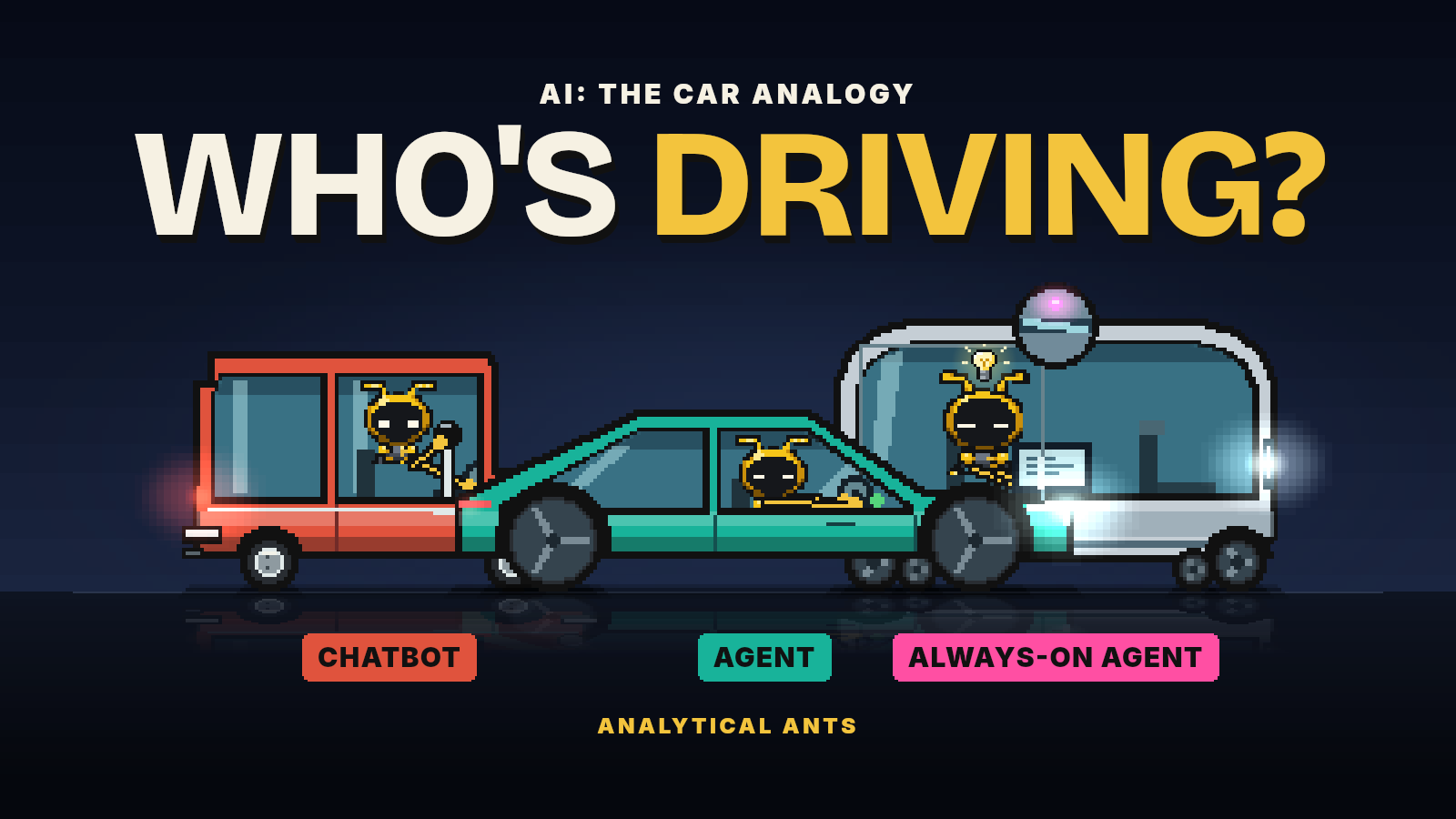
Since September 3, five of the major AI companies have launched or opened an always-on AI agent, one that works in the background and starts when something happens. So which AI should you pick?
TL;DR
- AI chatbot vs agent vs always-on agent isn't a contest of intelligence; the leading assistants run comparable AI models. The real choice is how much of a job you hand over. A chatbot drafts from what you bring, an agent gathers the files, and an always-on agent starts when a request arrives. Checking and approving stays with you.
- You'll be able to map one recurring job in four rows: who starts it, who gathers the files, who writes the draft, and who checks and approves.
- The new always-on agents from the largest AI companies all describe asking before steps that need your approval, like sending or paying. On those sensitive steps, asking first is the design, not a limitation. Some products let routine actions run without asking.
- AI Readiness & Enablement helps a team choose that first job.
Why is "which AI is smartest?" the wrong question?
For most work, the leading assistants run comparable models. Each is a frontier model, meaning today's most advanced AI. Scoreboards such as Artificial Analysis and LMArena's public text ranking put different models first, so any ranking is a moving target.
The film puts it plainly: "Frontier model 1 or 2? For most work, either can help." One can still feel smarter. It's already in your inbox, so it starts with more of your context. That's convenience, not a better engine.
Choosing by ranking has a cost. A team picks a winner, then keeps doing the copying and checking it hoped to hand over. What changes the result is how much of the work you hand over.
What changes when you hand over more of the job?
Each handover moves one row of the job from you to the AI. The film's job card, "Update Bob's quote," has four rows: who starts it, who gathers the files, who writes the draft, and who checks and approves. The engine never changes. Only the owner of each row does.
Chatbot, the stick shift: you bring the files
A chatbot is a chat window: you type or paste, and it answers. You bring Bob's old quote and the prices, it writes the draft, and you check it and send it. Like a stick shift, every handoff is yours, which suits occasional work.
Agent, the automatic: it gathers the files
An agent is AI that can open the files you allow and do the steps itself. You start the job. It finds Bob's last quote and the price list and drafts the revision, and you check it and send it. Like an automatic, it shifts for you, but you're still driving.
Always-on agent, the robotaxi: Bob's email starts it
An always-on agent waits in the background and starts work when something happens, not when you type. As the film puts it: "Tell it once: watch for quote requests. Ask me first." Bob's email arrives, and that starts the job. The agent gathers the files, drafts the quote and brings you the decision. Nothing goes out until you approve. Self-driving cars work the same way: SAE describes its Level 4 as "automated driving under defined conditions." An always-on agent, too, works only inside the rules you set.
Who does what on Bob's quote
| Update Bob's quote | Chatbot (stick shift) | Agent (automatic) | Always-on agent (robotaxi) |
|---|---|---|---|
| Starts it | YOU | YOU | BOB'S EMAIL |
| Gathers the files | YOU | AI | AI |
| Writes the draft | AI | AI | AI |
| Checks & approves | YOU | YOU | YOU |
The bottom row never moves. More delegation changes your role. It doesn't remove your responsibility.
Which always-on agents launched this year, and how do they ask first?
Five of the major AI companies launched or opened an always-on agent between September 3 and October 21, 2026, and Google announced its own in May. Each describes asking before it acts on steps that need your approval, such as sending a message or making a purchase. Here is what each one says.
| Agent | Company | Date | How it asks before acting |
|---|---|---|---|
| Claude Duet | Anthropic | Oct 21, 2026 (early preview) | Before it sends a message, makes a payment, signs a document or deletes anything, it "shows you exactly what it's about to do and waits for your approval." |
| dots | OpenAI | Sep 29, 2026 | Rules for each action, including "ask before taking action" and "hand off to you," as reported by DataCamp. |
| Autopilot | Microsoft | Sep 25, 2026 (invite-only preview) | "Sensitive actions can require a human to sign off before they proceed," Microsoft says. |
| Muse | Meta | Sep 8, 2026 | "Muse checks with the person before sensitive actions like sending an email or making a purchase." |
| Grok Bot | SpaceX's AI arm (formerly xAI) | Test version Aug 11, 2026; opened to businesses Sep 3 | Bots "only come back when something needs your approval." |
| Gemini Spark | Announced May 19, 2026; renamed "Task" in the Gemini app Oct 12–13 | "Designed to ask for your review and confirmation before it completes certain actions," such as sending communications and making purchases, per Google's help page. |
On sensitive steps like sending or paying, asking first is the design, not a limitation. These companies are competing to take on more of your work, and each still describes a person approving the steps that need it. Anthropic goes further: some actions are off-limits to Claude Duet even with your approval, such as moving money between accounts.
Some products let routine actions run without asking, and each draws that line differently. So the rule you write matters more than the brand you pick. Near the end, the film says: "Checking and approving always stays with you."
How do you start on Monday?
Pick one recurring job, not a product. Write down who starts it, who gathers the files, who writes the draft and who approves. Hand the AI one row at a time, starting with the draft, and keep approval with a named person. The first two steps need only a pen and the people who do the work.
1. Pick one recurring job
Choose work that arrives often, follows a pattern and has a clear finished form, such as:
- answering quote or estimate requests;
- confirming and rescheduling appointments;
- reminding clients about overdue invoices;
- collecting documents from clients before a deadline.
For a first job, skip anything where one mistake is expensive or hard to undo.
2. Write its four rows
Use the film's job card and write who does each row today:
- Starts it: an email, a date, a phone call?
- Gathers the files: which records, and where do they live?
- Writes the draft: what does finished look like?
- Checks & approves: who says yes before it goes out?
If a row is hard to fill in, fix that first. AI won't make an unclear job clear.
3. Hand over one row at a time
Start with "Writes the draft," a chatbot job. When the drafts are reliably right, hand over "Gathers the files," with access only to the folders that job needs. Only then consider "Starts it," so the job begins when the email or report arrives. For overdue-invoice reminders:
| Overdue-invoice reminders | Today | 1. The draft (chatbot) | 2. The files (agent) | 3. The start (always-on) |
|---|---|---|---|---|
| Starts it | YOU | YOU | YOU | OVERDUE REPORT |
| Gathers the files | YOU | YOU | AI | AI |
| Writes the draft | YOU | AI | AI | AI |
| Checks & approves | YOU | YOU | YOU | YOU |
4. Write the rule once
An always-on agent needs its instructions in writing. The film's version: "Tell it once: watch for quote requests. Ask me first." Yours should say what to watch, what it may read, what it drafts and what needs your yes. For the invoice job:
5. Keep "Checks & approves" with a named person
Write a name in the bottom row, not "the team" and never "the AI," plus a backup: "Dana approves; Luis covers when she's out." Each week, that person also reviews a few finished jobs, including ones the agent didn't ask about.
What do people get wrong about handing work to AI?
The common mistake is treating the most hands-off option as the goal. A robotaxi isn't better than a stick shift; it suits a different trip. The other is treating approval as a temporary limit that smarter AI will remove. Approval is how responsible delegation works.
Two more are easy to miss:
- Access isn't permission. An agent that can read your price list may not offer Bob a discount.
- A customer's message isn't an instruction. Outside text can try to redirect an AI, called prompt injection, and OWASP, a nonprofit security project, ranks it first among AI application risks.
What does Analytical Ants build, and what haven't we built yet?
We build applications around real work, with AI where it earns a place, and we help teams decide how much of that work to hand over. We delivered the Atlas Brotherhood membership and coaching platform for a client, and our sister company is developing Cutgraph Studio. We have not yet built a full always-on agent ecosystem for a client.
The film above was made in Cutgraph Studio, a video tool our sister company has in development. Its built-in AI assistant proposes edits, and the person accepts each one. That's the automatic drive in practice: help with the steps, hands on the wheel.
Holding back on always-on work is deliberate: we start with drafts people review, and agree who approves before any permission expands. Our AI readiness service helps a team choose its first job, Application Development builds the software around it, and Leadership & Ongoing Support provides technical direction afterward.
Frequently Asked Questions
What is the difference between an AI chatbot and an AI agent?
A chatbot works with what you bring it: you paste in the old quote and the prices, it writes a draft, and you check and send it. An agent opens the files you allow and gathers what it needs itself before drafting. With both, you start the job and you approve the result.
What is an always-on AI agent?
An always-on agent waits in the background and starts work when something happens, such as a customer's email, instead of when you type. It gathers the files and drafts the work, then asks before sensitive steps like sending or paying. Several major AI companies launched or opened one in September and October 2026.
Will an always-on agent send emails without asking me?
The leading products describe asking before steps that need your approval, such as sending a message or making a payment. That doesn't cover every action, and each product draws the line differently. So write it into your rule: "Ask me before anything goes out." Then have a named person check finished work to confirm the agent follows it.
Has Analytical Ants built an always-on agent for a client?
No. Analytical Ants has not yet built a full always-on agent ecosystem for a client. We delivered the Atlas Brotherhood membership and coaching platform for a client, and our sister company is developing Cutgraph Studio, whose built-in AI assistant proposes edits that a person accepts one by one. We start with work people can review.
If you'd like a second pair of eyes on your first job card, tell us about your work. We'll help you choose the row to hand over first.
About the author: William Rodriguez is the founder of Analytical Ants. He builds applications around real work, helps teams decide how much of that work AI should handle, and directed the film above. More about Analytical Ants.